
Much will depend on how the protagonists use the current interlude to work proactively for the beginning of a durable settlement or, on the contrary, prepare for a new round of escalation, points out Ambassador M K Bhadrakumar.

Pakistan Prime Minister Shehbaz Sharif clarified that the recent Memorandum of Understanding (MoU) signed between the US and Iran does not include provisions regarding Tehran's ballistic missile programme. This statement followed talks with Iranian President Masoud Pezeshkian, with Sharif emphasising Iran's right to its defence capabilities and Pakistan's role as a mediator in the US-Iran peace process.

United States President Donald Trump and Iranian President Masoud Pezeshkian have virtually signed a 14-point memorandum of understanding (MoU) to end hostilities, reopen the Strait of Hormuz, and begin a 60-day negotiation process on sanctions and Iran's nuclear programme.

Pakistan and Qatar have successfully mediated separate meetings between US and Iranian negotiators in Doha, reporting positive progress on a Memorandum of Understanding aimed at West Asian peace. Further discussions are planned after the funeral of former Iranian Supreme Leader Ayatollah Ali Khamenei.

Following a Memorandum of Understanding between the US and Iran to resolve the West Asia conflict, eleven India-bound vessels have successfully transited the Strait of Hormuz. This development signals a positive shift for maritime trade, with more Indian-flagged ships expected to pass through the crucial waterway soon.
Top leaders from the US, Iran, and Pakistan, along with other nations, have gathered in Switzerland for high-level talks aimed at restoring peace in West Asia. These negotiations follow a recently signed Memorandum of Understanding between the US and Iran, initiating a 60-day window for a deal. Discussions focus on Iran's nuclear programme and the fragile interim peace deal, amidst renewed tensions and the fluctuating status of the Strait of Hormuz.

The US and Iran have agreed on a roadmap aimed at reaching a final agreement within 60 days after hours-long talks at the Swiss resort of Burgenstock, mediators Qatar and Pakistan said on Monday, describing the progress as "encouraging."

As Tehran and Washington continue with their engagements following the signing of the MoU earlier this month, sources have told Al Arabiya that the two are set to hold the next round of negotiations in Switzerland on June 28 and 29.

Indian benchmark equity indices, Sensex and Nifty, extended their rally for a fifth consecutive session, driven by optimism surrounding a potential US-Iran peace deal and a significant drop in crude oil prices. Despite hawkish remarks from the US Fed, investors remain hopeful that easing energy prices could temper inflationary pressures.

The United States and Iran are scheduled to hold their initial round of talks in Switzerland on Friday, following a ceasefire agreement virtually signed by US President Donald Trump and Iranian President Masoud Pezeshkian.

Pakistan Prime Minister Shehbaz Sharif on Thursday signed the historic peace deal between the United States and Iran as a guarantor; the agreement will see the immediate reopening of the Strait of Hormuz and the lifting of the US naval blockade.
Pakistan capital Islamabad is emerging as the leading venue for the next round of technical negotiations between the US and Iran, a media report said Sunday.

In a significant diplomatic development, US and Iranian negotiators have reportedly reached a tentative 60-day memorandum of understanding (MoU) aimed at extending a fragile ceasefire and paving the way for formal talks regarding Iran's nuclear programme.

Donald Trump has issued a severe warning to Iran, threatening 'decimation' with '1,000 missiles' if the nation pursues alleged assassination plots against him, while Iranian officials accuse the US of violating a MoU amidst ongoing diplomatic talks.

Iran's state broadcaster IRIB reported that the Qatari oil tanker "Al-Raqayat" was targeted in the Strait of Hormuz after allegedly ignoring Iranian warnings and attempting to transit with US Navy support. This incident follows the expiry of a US-Iran agreement to halt strikes and comes amidst escalating tit-for-tat attacks in the vital waterway, raising concerns about maritime security.
A high-stakes memorandum for a 60-day ceasefire between the United States and Iran is in its final stages, with negotiators working to close remaining gaps and avert further escalation in the region, including reopening of the Strait of Hormuz and the resumption of Iranian oil sales, according to an Axios report citing US officials.

US Special Envoy Steve Witkoff and Iranian Foreign Minister Abbas Araghchi are reportedly heading to Switzerland for a new round of US-Iran negotiations, following a recently announced memorandum of understanding to end hostilities in West Asia and a ceasefire between Israel and Hezbollah.

US Vice President JD Vance has postponed his visit to Switzerland for technical talks with Iranian negotiators, citing logistical issues. These negotiations are crucial for finalising the details of a recently signed peace deal between the US and Iran, which aims to end the conflict in West Asia and includes a 60-day period for technical discussions.

The United States and Iran could resume negotiations as early as next week in Islamabad, according to a report by The Wall Street Journal citing people familiar with the matter.

Iranian President Masoud Pezeshkian is on a state visit to Pakistan to discuss the full implementation of an agreement signed between Iran and the US, alongside regional and international developments. The visit also aims to strengthen bilateral cooperation across various sectors, following recent high-level talks between the US and Iran in Switzerland regarding regional security.

The United States on Saturday (local time) launched a third round of strikes against Iran after alleging that Iran's Islamic Revolutionary Guard Corps (IRGC) attacked the Cyprus-flagged container vessel M/V GFS Galaxy in the Strait of Hormuz.

US Vice President J D Vance is currently in Switzerland, leading critical technical talks with Iran to advance diplomatic efforts on Iran's nuclear programme and secure a lasting ceasefire in Lebanon, following a recently signed memorandum of understanding aimed at de-escalating West Asian hostilities.
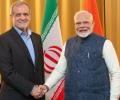
Prime Minister Narendra Modi held a telephonic conversation with Iranian President Masoud Pezeshkian, discussing recent developments in West Asia and reiterating India's emphasis on the importance of freedom of navigation in the Strait of Hormuz. Modi welcomed the recent peace understanding between the US and Iran, stressing dialogue and diplomacy for regional stability. India will also send representatives to the burial ceremonies of Iran's late Supreme Leader.
Indian benchmark indices Sensex and Nifty recovered early losses to trade higher, supported by encouraging developments on the geopolitical front, specifically the US-Iran peace deal, and easing crude oil prices.
Following the signing of a 14-point Memorandum of Understanding (MoU) with Iran, US President Donald Trump reiterated the terms for a 60-day negotiation period, vowing that Tehran will receive "not ten cents" in financial relief.

Indian benchmark equity indices, Sensex and Nifty, ended lower after a five-day rally, with the Sensex dropping 607 points and the Nifty falling to 24,013.10. The decline was primarily driven by heavy selling in IT firms following Accenture's trimmed revenue guidance and renewed geopolitical uncertainty, specifically the postponement of US-Iran negotiations.

A US-Iran memorandum of understanding is set to be signed, outlining sanctions relief, the reopening of the Strait of Hormuz, and a 60-day negotiation window for Iran's uranium enrichment, but US President Donald Trump has underscored the deal's conditional nature, warning of military action if Tehran fails to comply.

The ceasefire is still technically holding, to the extent that no overt hostilities have been reported yet, but the rhetoric has hardened dangerously. The week ahead will also clarify whether the Islamabad failure was a negotiating tactic or whether Washington has genuinely locked itself into a position from which the only exits are climb-down, escalation, or the slow bleed of a new status quo that nobody chose and nobody controls. Prem Panicker continues his must read blog on the Iran War.

India and Israel have elevated their relationship to a special strategic partnership, focusing on enhanced cooperation in trade, technology, and defense, while also addressing regional peace initiatives.
